How mobile connectivity works.
A closer look at the mobile connectivity solutions that bring reliable cellular service indoors.
Welcome Inside
Across the country, property owners are upgrading their buildings to keep pace with the demands of today’s hyper-connected tenants, guests, employees and shoppers alike. And one of the biggest questions we hear is:
“Why isn’t the cellular service inside my building as reliable as it is outside—and what can I do about it?“
For most commercial buildings, the answer lies in mobile connectivity—solutions like Distributed Antenna Systems (DAS), Wi-Fi and Private Networks.
DAS is the foundation for enterprise-grade indoor cellular, making it the primary focus of this story. Wi-Fi and Private Networks play complementary – but slightly different – roles:
- Wi-Fi delivers high-capacity, localized connectivity—ideal for web browsing and applications where mobility, safety and security are not mission-critical.
- Private Networks provide secure, controlled wireless for IoT and operational systems, making them especially valuable in environments like manufacturing plants and hospitals.
But when people say, “I can’t make a call” or “I’ve installed a new app, but it doesn’t work in my building,” the system that solves that problem is almost always DAS.
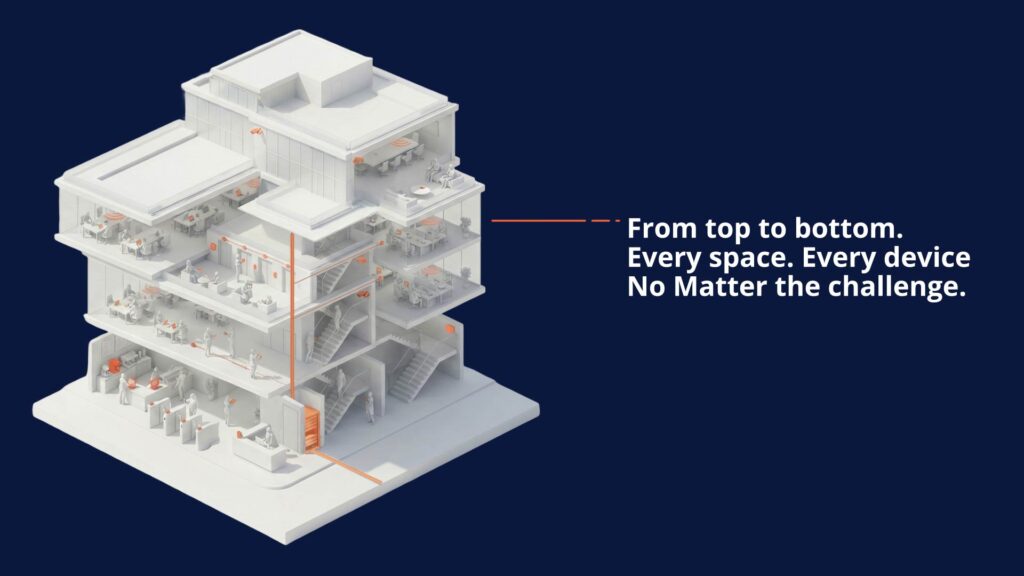
So let’s walk through what’s happening inside a fictional commercial building, Universal Plaza, and why connectivity challenges occur, even when everything seems like it “should” work.
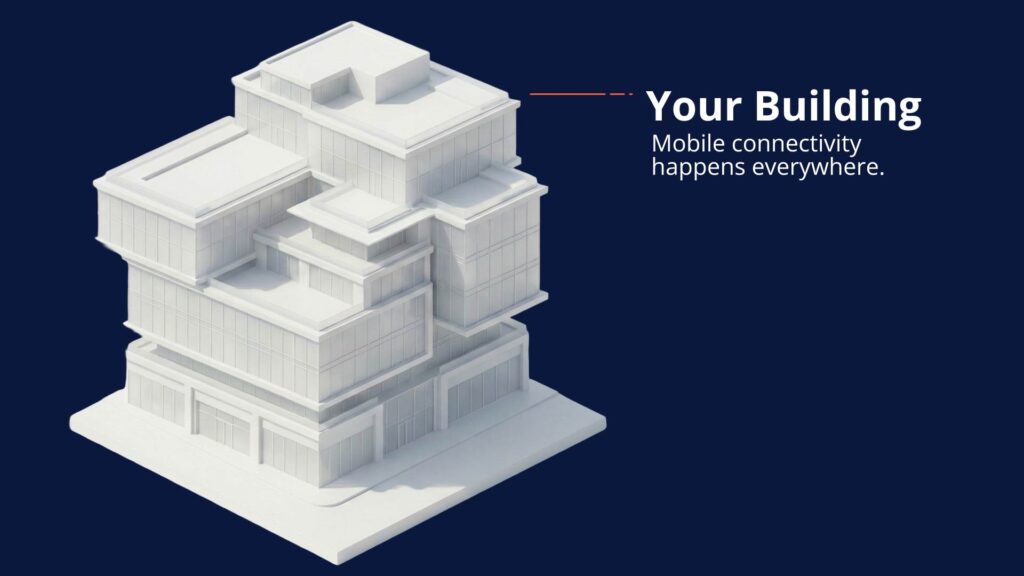
The Problem: Inside Universal Plaza, devices are not connecting.
Universal Plaza is a mid-sized office and retail building built nearly 20 years ago. Like many buildings of its time, cellular coverage was never part of the design plan. The macro cell towers outside provide strong coverage, but inside the building? Not so much.
Tenants and visitors start noticing a frustrating trend:
- Full bars, but calls don’t go through
- Texts delay or fail
- Mobile apps time out
- Payments at the coffee counter don’t process
- Security and operations teams can’t reach each other at peak times
Even though there is a tower nearby, having coverage outside doesn’t guarantee usable capacity inside. And modern buildings are only making the problem worse.
Why? Because the building itself blocks the signal.
New materials—low-E glass, reinforced concrete, energy-efficient insulation—act like a shield. Devices think they’re connected, but the outside network cannot reliably reach them.
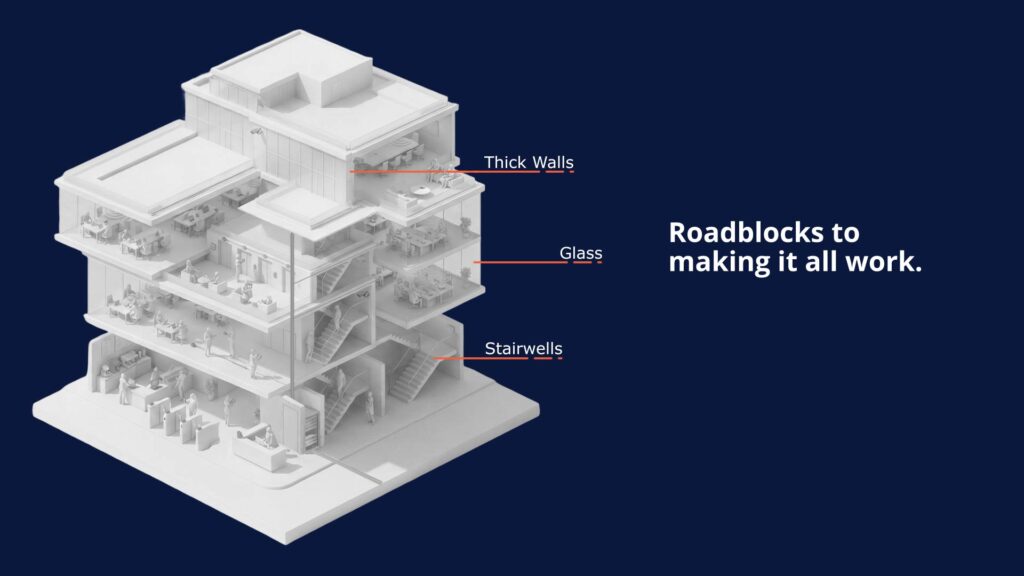
Demand inside the building has exploded.
In the last decade, mobile usage inside the building has skyrocketed:
- Tenants work on highly mobile apps
- Guests stream video constantly
- Retailers rely on mobile payment systems
- IoT sensors are everywhere – from turnstiles to occupancy tracking
- Building operations depend on mobile for staff communications
- Safety systems increasingly rely on mobile notifications and connectivity
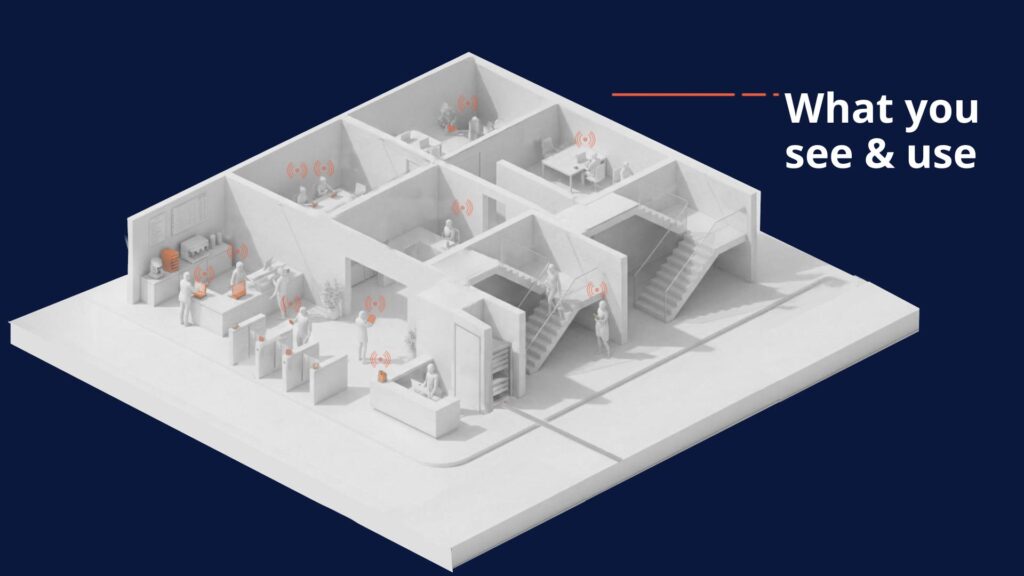
Wireless Coverage vs. Capacity:
This is where two ideas become critical:
- Wireless Coverage = Can the cell signal reach my building?
- Wireless Capacity = Can the network handle everything happening inside my building?
Universal Plaza may technically have some coverage, but it absolutely does not have the capacity to support how people use their devices indoors. The macro towers were not design for indoor density.
Find your challenge.
Struggling with spotty cellular coverage in your building?
The Fix: A modern mobile connectivity solution—centered on DAS.
To fix connectivity inside Universal Plaza, the property owners install a Distributed Antenna System (DAS).
A DAS works by:
- Bringing Wireless Carrier cell signal into the building—directly through dedicated Wireless Carrier signal source from AT&T, Verizon or T-Mobile, or from an Over-The-Air (OTA) repeater.
- Distributing that signal through fiber and / or coaxial cable to dozens of strategically placed antennas throughout the property.
- Blanketing the entire building with consistent, high-quality mobile coverage and capacity.
What does the Universal Plaza DAS include?
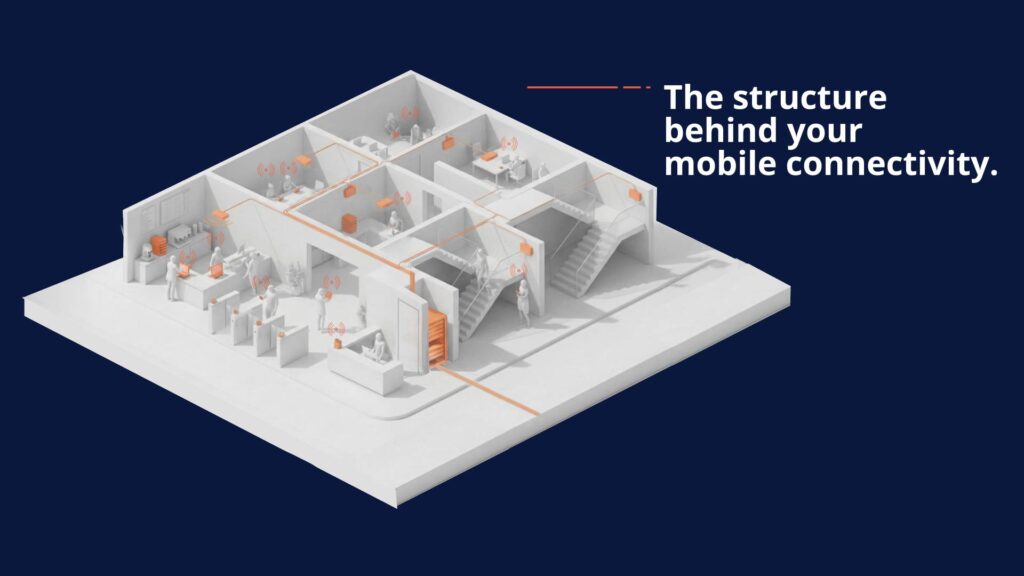
- Cellular Signal Source: This is how Universal Plaza brings carrier-grade cellular service into the building. It’s the foundation of the entire DAS. The cell signal (often referred to as “RF signal source”) can come from an Over-the-Air (OTA) repeater or directly from Wireless Carriers through a dedicated connection.
- Headend Equipment: Think of the headend as Universal Plaza’s connectivity command center. It receives the signal from multiple Wireless Carriers, processes it and then distributes it throughout the building over fiber or coaxial cabling.
- Remote Antennas: These compact, low-profile antennas are placed strategically across Universal Plaza to broadcast consistent, high-quality cellular coverage everywhere tenants, staff and guests need it.
What about Wi-Fi?
Wi-Fi still plays an important, complementary role to DAS. A DAS is your major highway—far reaching and travels with you. Wi-Fi is a private road off the highway—focused on a specific area and limited to those boundaries and speed limits.
How it Works: Implementing a DAS.
Installing a DAS involves dozens of steps to design, fund, install, operate and maintain. Universal Plaza hires a third-party operator to provide a managed service, neutral-host DAS for their property.
What is a “neutral host“ DAS and why is it right for Universal Plaza?“
“Neutral host” means a single shared infrastructure that supports Multiple Wireless Carriers (AT&T, Verizon and T-Mobile) at once. Instead of each Wireless Carrier installing its own system, a neutral-host DAS provides one platform that everyone can connect to—reducing cost, improving coverage and delivering a better experience for all users inside Universal Plaza.
Traditionally, when a Wireless Carrier deploys a DAS inside a building, the system is primarily designed to support that Carrier’s own network. While additional carriers can sometimes be added, these deployments are typically optimized around a singular Carrier’s standards rather than multi-carrier use.
Neutral-host, three Carrier deployments ensure Universal Plaza tenants, guests and shoppers can operate no matter their Wireless Carrier—AT&T, Verizon or T-Mobile.
Universal Plaza’s DAS deployment involves collaboration to build a custom-fit solution for their unique building and industry requirements. Key elements of this complex process include:
- RF design: solution experts model every floor to ensure consistent coverage and capacity. This includes determining where the DAS headend is located, the number of antennas and their placement and a standard diagram so Universal Plaza can know exactly what to expect.
- Wireless Carrier engagement: because their DAS uses dedicated signal over licensed spectrum, Wireless Carriers must integrate their signal and approve performance.
- Aesthetic considerations: antennas are designed for minimal visual impact.
- Construction and integration: fiber, headend equipment and antennas are installed with minimal disruption.
- Safety and compliance: all systems follow FCC RF rules and local building codes.
The Benefits: Universal Plaza today.
Before DAS, every device inside Universal Plaza tried to reach the few macro towers outside—creating congestion and dead zones.
After DAS, dozens of indoor antennas move the point of connection from outside miles away, to inside just feet away. Even better, the neutral-host DAS supports multiple carriers—ensuring everyone benefits, no matter their provider.
With DAS in place, Universal Plaza feels like it finally “works” again with consistent cell connectivity across every floor, room and corner:
- Tenants enjoy flawless calls and fast mobile data
- Retailers process payments quickly
- Facility teams connect instantly
- First responders connect and emergency alerts work reliably
- Emergency calls are guaranteed
- Guest experiences improve
- IoT and building systems perform more efficiently
- Property value and leasing competitiveness go up
Meanwhile, Wi-Fi continues to do what it does best—without the added burden of supporting cellular coverage it’s performing better than ever.
Ready for the Future.
DAS positions Universal Plaza for what comes next:
- 5G updates with an upgrade path to 6G and beyond
- Smart building platforms for energy efficiency and water filtration
- Advanced sensors for personalized experiences
- Robotics, AR/VR, autonomous operations and networks
Because the backbone is already in place, new technologies can be supported simply by upgrading network equipment—not ripping walls open again. And because Universal Plaza has a managed service, continual technology upgrades are covered.
Universal Plaza is now fully prepared for the digital demands of the future and the people inside finally get the mobile experience they expect. It just works.
Be the next Universal Plaza.
Discover how a neutral-host DAS can ensure every tenant, guest and device stays connected— ensuring reliable phone service while boosting productivity, engagement and revenue for your building.