Distributed Antenna Systems (DAS)
Seamless cellular coverage for every corner of your property.
Fast, reliable mobile connections—everywhere.
You hear complaints first: “I can’t connect.” “My calls keep dropping.” Weak mobile coverage leads to immediate friction for tenants, employees, shoppers and guests. A Distributed Antenna System (DAS) from TDC brings Wireless-Carrier grade, seamless mobile coverage inside your building—giving you the power of a dedicated cellular system, delivered as a managed service with no upfront cost.
Mobile connectivity by the numbers.
of our data traffic is consumed indoors.
in 10 calls to 9-1-1 originate from a mobile phone.
of tenants say “connectivity quality” is second only to location.
Your DAS, your way.
Our DAS solutions take Wireless Carrier signals and redistribute them throughout your property through a series of strategically placed antennas. It takes a weak wireless signal and distributes it evenly—eliminating dead zones.

Custom-fit
Client solutions engineers work side-by-side with you to design a DAS network that meets your specifications.

Partner agnostic
We partner with multiple OEM and solution providers—selecting the right technical approach after understanding your unique business needs.

No upfront cost
No upfront capital investment enabled by our Network-As-A-Service (NaaS) OpEx model.

Managed as if it were you
We act as an extension of your team, managing everything from stakeholder coordination to securing Wireless Carrier signal sources and all the steps in between.

Hiding in plain sight
Our design experts align the system to your aesthetic standards—including concealed equipment.

Flexible architecture
Our DAS solutions can be Fiber, Cat6A, Coaxial Cable or Hybrid based, depending on your requirements.
Industries powered by DAS.
 Commercial Real Estate
 Hospitality
 Retail
 Gaming & Entertainment
 Financial Institutions
 Healthcare
 Higher Education
 Manufacturing
 Transportation
Indoor or outdoor—we’ve got it covered.
Great mobile connectivity doesn’t stop at the back door. Whether coverage is needed inside your building, across your campus or in outdoor spaces, TDC designs and operates the right DAS solution for your business – indoor, outdoor or both – delivering seamless signal everywhere people live, work and play.
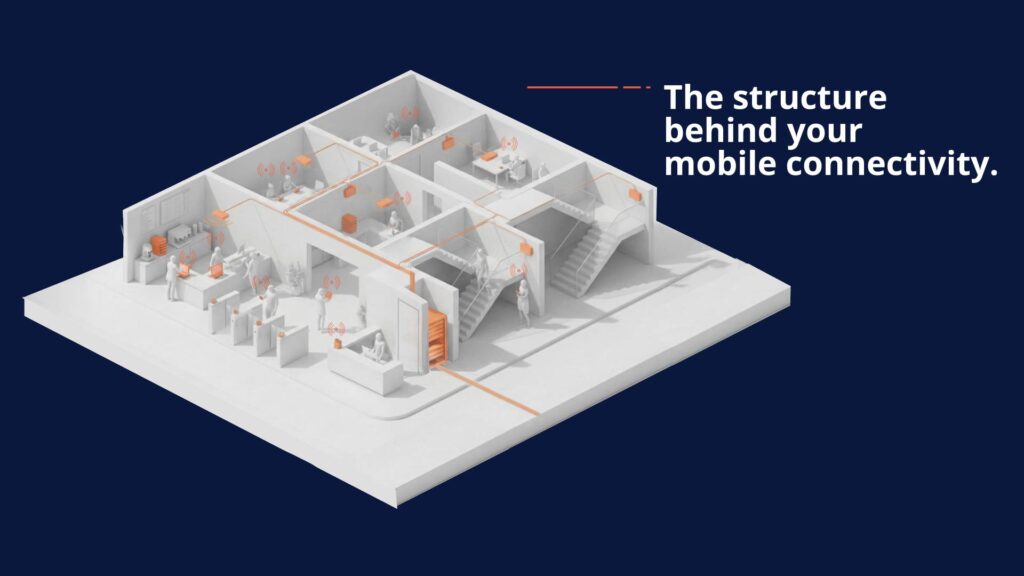
Indoor DAS (iDAS)
Designed to deliver strong, reliable cellular signal inside structures where macro networks can’t reach. It overcomes RF-blocking materials like concrete, steel and Low-E glass to ensure phones and devices work indoors. Ideal for buildings where indoor performance, capacity and tenant experience matter most.
Outdoor DAS (oDAS)
Extends cellular coverage across large outdoor environments where traditional macro towers fall short. It’s built to support high-user density, mobility and events—delivering consistent signal across mixed use spaces, parks and campus-style developments. It keeps people connected as they move, gather and scale.
Transforming connectivity into a strategic value driver.
Connectivity performs better—and costs less—when experts run it. TDC manages, operates and upgrades your network turning it into a scalable business advantage.
No upfront investment
Replace capital-heavy infrastructure with a predictable model that requires no upfront investment.

Reliable, always-on performance
Keeps guests, tenants, shoppers, employees and visitors happy with connectivity that runs on modern, continuously updated technology.
Allows your team to focus where it counts
When TDC manages the network, your team can focus on running your business.
Built to scale and evolve
Flexible architecture that grows with your property, your tenants, and your business—scaling securely and efficiently, with no need for a rebuild.
What our partners and customers say about TDC.

“Hood Park is built on cutting-edge technology that enhances how tenants live, work and play. TDC advances that vision with deep CRE expertise shaped by real-world experience. They’re not just a technical solution—they’re a true business partner.”
500 Rutherford Avenue
“From the day we started the project until the system went live, the Tillman team was great to work with and exceeded our expectations. Everything we agreed to in the contract was fully executed to our satisfaction.”
Concord Hospital
“The TDC team—from sales to engineering or project management—is always extremely responsive and fully prepared. This allows us a partner to be more precise and accurate in performing our responsibilities. As a partner, I would trust them with any opportunity.”
M-Communications
Real answers to DAS misconceptions.
Mobile connectivity is changing by the day. When you partner with us, we bring the transparent guidance and seasoned insight today’s complex connectivity decisions demand.
I need 5G.
Bust the Myth 
Today’s 5G comes in two types: one that builds on existing 4G networks and one that uses new, high-frequency spectrum. The 4G-based 5G works well for everyday activities like streaming, video calls and social media, is widely available and affordable and works on most phones. The high-frequency version is faster and better for heavy use—like multiple ultra-HD streams, gaming, AR/VR and smart buildings—but is still evolving, is not yet everywhere and needs a 5G-compatible device. It’s best for busy places like stadiums, airports or large offices where the investment aligns with the value to the venue.
We can rely on a single Wireless Carrier.
Bust the Myth
Tenants, guests, employees and shoppers need reliable, always-on connectivity. Depending on one carrier creates dead zones, reduces redundancy and increases risk for critical communications, especially in thick-walled and waterfront properties, old buildings, stairwells and basements.
We’ll deal with it after construction.
Bust the Myth
Delaying usually increases costs and disrupts operations. Early design ensures coverage, compliance and efficient operations from day one—saving on average of 20% when implemented before the walls are constructed.
DAS is only for stadiums or huge campuses.
Bust the Myth
That’s a common misconception. While DAS is well known for stadiums and large campuses, it’s increasingly deployed in office buildings, hospitals, hotels, manufacturing facilities, airports and high-rise residential properties. Any environment where cell service struggles—due to building materials, density, or critical communications needs—can benefit from DAS. Today, DAS is as much about reliable day-to-day connectivity, safety and business operations as it is about serving massive crowds.
Wi-Fi can replace cellular.
Bust the Myth
Wi-Fi and cellular solve different problems and are complementary. Think of a DAS like your major highway, far reaching and travels with you. Wi-Fi is like a private road off the highway—focused on a specific area and limited to those boundaries and speed limits. Wi-Fi delivers high-capacity, localized connectivity and is good for data on known devices, but it can’t replace cellular for things like voice calls, mobile payments, public safety and security, critical business applications or indoor to outdoor use cases. Cellular DAS or Private Networks provides higher reliability, better mobility and stronger security. Most buildings need both Wi-Fi and cellular working together.
If the signal is good outside, it’s good inside.
Bust the Myth
Not necessarily. A strong outdoor signal doesn’t guarantee reliable indoor coverage. Building materials like concrete, steel, low-E glass and even modern insulation can significantly block or weaken cellular signals once you are inside a building. That’s why many properties show “full bars” outside but experience dropped calls, slow data or dead zones inside—especially in elevators, stairwells, basements and interior rooms.
FAQs about DAS.
How does a DAS work?
A DAS includes a series of strategically placed and distributed antennas that repeat cell signal into multiple areas of a property. The Wireless Carrier cell signal is processed through a headend which transmits it through cables (Fiber or coaxial) to the network’s antennas throughout the building.
How does a DAS improve connectivity inside a property?
By positioning strategically placed antennas in multiple areas, the DAS amplifies cellular signal and mitigates “dead zones” that don’t receive signals from the outside.
Where does the DAS get cell signal?
Every Distributed Antenna System (DAS) must have a Wireless Carrier signal source to work. Think of a DAS like a sound system: the antennas are the speakers, but you still need music to play. The signal source is that “music” – the actual cellular signal from the Wireless Carrier from AT&T, Verizon or T-Mobile. Without signal, a DAS has nothing to amplify or distribute and your building won’t get improved coverage.
Cell signal can be achieved directly through dedicated Wireless Carrier signal source from AT&T, Verizon or T-Mobile (BTS), or from an Over-The-Air (OTA) repeater using a bi-directional amplifier (BDA).
What is a Network as a Service (NaaS) DAS offering and how does it differ from traditional DAS?
DAS as a Network-as-a-Service is a turnkey solution where a third-party operator (3PO) designs, installs and manages your Distributed Antenna System (DAS). Unlike traditional DAS, you don’t need to buy, own or maintain the equipment—everything is delivered as a managed service, with a predictable and monthly operating expense.
What is a “neutral-host” DAS?
Neutral host means a single shared infrastructure that supports Multiple Wireless Carriers (AT&T, Verizon and T-Mobile) at once. Instead of each Wireless Carrier installing its own system, a neutral-host DAS provides one platform that everyone can connect to—reducing cost, improving coverage and delivering a better experience for all users in the building.
Traditionally, when a Wireless Carrier deploys a DAS inside a building, the system is primarily designed to support that Carrier’s own network. While additional carriers can sometimes be added, these deployments are typically optimized around a singular Carrier’s standards rather than for multi-carrier use.
What is the average technology cycle on a Distributed Antenna System (DAS)?
While technologies like Wi-Fi evolve rapidly with a shorter lifecycle, the industry standard for a DAS is along an 8-10-year technology refresh rate. In the latter half of a ten-year solution, the equipment and cabling are out of warranty and things may begin to break. That’s why NaaS solution models – like the model at TDC – are favored by enterprises because they act as an insurance policy, including all maintenance, repairs, spares and upgrades.
Will you purchase my aging DAS solution?
Yes. We offer a buyout lease program that replaces your aging DAS with a future-ready solution, without the upfront capital. We assess the value of your existing infrastructure and convert your CapEx model into a lease, bundling all future repairs, maintenance and upgrades into one predictable monthly payment. You get a new DAS with the latest technology and lasting property value, while preserving your capital for other enhancements. Facing this challenge today? Let’s talk.
Let’s talk.
Want to learn more about how a DAS enables you to deliver seamless wireless connectivity across your property? Talk to one of our experts today.